
The ultimate guide to effective minute-taking
As we all know, writing minutes is an essential skill for Assistants. This ultimate guide to effective minute-taking will break down everything Assistants need to know to create minutes that will be read and actioned, teaching you effective minute-taking techniques.
A few years back, I had a job that provided support for twelve Committees that had four meetings a year, which meant I wrote a set of minutes practically every week.
As you can imagine, I got pretty good at bashing out minutes without much thought behind them, but no matter how comfortable I found writing the minutes, the process still took forever.
I soon realised that thought was required to write a good comprehensive set of minutes, and just typing out what I had written down wouldn’t make what I considered a painful task any less arduous.
In this ultimate guide, we are going to give Assistants loads of tips on good minute-taking and all the tools they need to create effective minutes, including:

So, for all of you who write minutes for meetings, don’t enjoy it, and take forever to complete the work, here are eleven minute-taking best practices that will help you get them finished, circulated, and out of your to-do tray as quickly as possible while still producing a quality piece of work.
Listening
Obviously! More than anybody else in the meeting, a minute taker needs to be listening 100 per cent of the time (no falling asleep here!).
Assertiveness
Minute takers must be confident to speak up in a meeting (where appropriate) and clarify points.
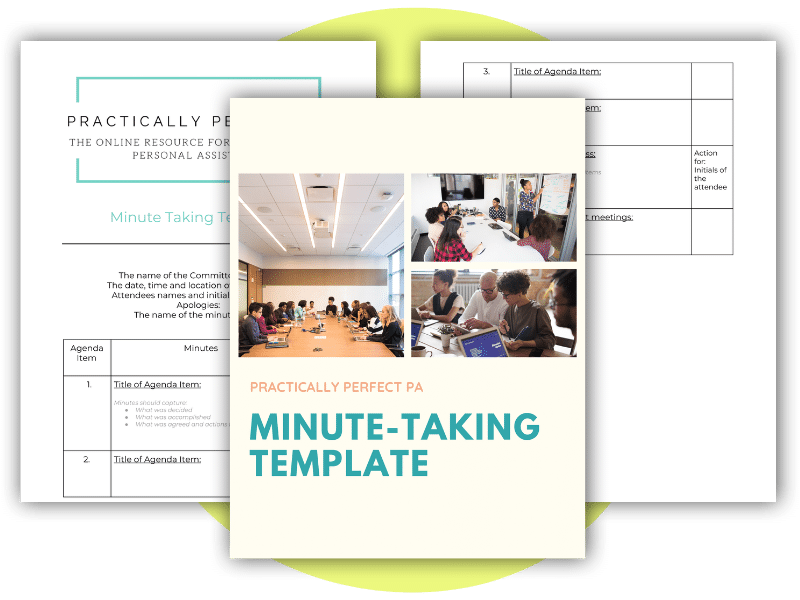
We have an awesome minute-taking template you can download and use for free.
Finalise the notes as quickly as possible.
Although the temptation is to leave this to the last minute, I wouldn’t recommend it.
Try and get the notes into a publishable format as soon as possible, ideally by the following day.
Even if you had become an expert at drafting minutes, you might still forget certain parts of the meeting and can’t quite decipher what you meant when you made the notes.
Also, if you get the minutes circulated quickly, you will give those with actions an early reminder to complete their work, which saves you time chasing them when the next meeting rolls around.
Organisation
Ensure you turn up to the meeting having read the agenda, any background papers, and the minutes of the previous session. Bring all the tools you need to take the minutes, whether a pen, highlighter, paper, recording device, laptop or iPad. Always carry an extra pen.
Avoid ‘he said, she said.’
You have to capture only three main areas of the conversation in your minutes, so try to avoid all of the chat and ‘he said, she said dialogue.
Leave this dialogue out of the minutes unless it is relevant to the critical agenda points.
Remain neutral
As the minute taker, try remaining unbiased when typing your notes.
I wouldn’t necessarily put this detail in the minutes if an argument occurred during the meeting or someone stormed out of the room. But, if your Chairperson indicates that you should include this level of detail, then remain neutral in your tone and choice of vocabulary.
Make the minutes readable.
I sometimes find with minutes that I will repeat the exact words repeatedly to describe the decisions made and actions agreed upon, particularly when I’m not really in the mood to write them!
Read the supporting papers.
This comes with time, but getting a real sense of what people discuss in the meeting makes writing the minutes after the session is much more manageable.
Try to read the papers beforehand and get to grips with the details.
If you don’t understand, spend 5 minutes with the Chairperson before the meeting to ask any questions you might have.
During the meeting, listen more than you write and summarise the details at the end of the discussion.
The more you listen, the more comfortable you will find subsequent meetings.
Use the correct grammar
The past tense is in the 3rd person.
This is the grammar when writing minutes; for example, Nicky Christmas agreed to distribute the minutes as soon as possible.
I would also recommend using initials rather than full names to save some time, but this is a style choice and may not suit all companies.
Do not add unnecessary detail.
If a report or paper has been circulated during the meeting, there is no need to write any detail in the minutes.
State that ‘the paper was noted by the Committee’ and then write down any action points from the discussion.
Proofread your work
Proofread your work once finished.
I tend to get everything on the page as quickly as possible and then go back a day later to tweak the wording and sentence structure.
At least two other people will probably proofread the minutes before they are finally circulated, so be prepared that some of your work will be changed.
How to make minute-taking an absolute breeze
Minute-taking is a much sought-after skill in organisations.
If you were wondering whether you are on track, what the latest trends are and keen to pick up some proven techniques, this session from Robyn Bennett at Minute Taking Madness is a must!
These tips, techniques and tools will help you to:
- Identify the number one skill required to be an effective minute-taker
- Discover the secret to minute-taking
- Learn the three proven methods to make minute-taking easier
This session will also give you access to extra resources to help you be a more successful minute-taker and plenty of tips on good minute-taking.
We have created a list of ten great tools, technology and software that can help make minute-taking more efficient and easier to manage.
This is an app for the iPad. It is designed specifically for people who handle tasks and need to follow up on actions from meetings. It is a digital notebook with an automated To-Do organiser, which syncs with calendars and address books. This would be handy for assistants if they want to take action points for their managers because it can sync with their task list.
This app lets users email notes immediately after the meeting and has a fully automated to-do system. There is an integrated audio recording, playback, and real-time collaboration and sharing facilities. Plus, it is free!
The Livescribe smartpen could be a good option if you prefer writing out your minutes. Users can write their minutes, as usual, using the Livescribe pen and paper and then transfer everything onto their computer. The programme will convert all of the writing into text. This can be done automatically using the Livescribe WiFi pen or connecting the pen to the computer with other models.
This is a quick and easy online minute-taking system. Users can take digital minutes immediately with a simple tab system for sorting notes and assigning tasks. It is helpful if you do not take minutes often or do not need to take formal minutes.
This system allows the user to track actions from each meeting and check the minute-taking completed. It also has an excellent report system that helps the immediately productive the meeting was!
Diligent
Diligent is a full board meeting and minute-taking software package covering every meeting management aspect.
Recording conversations right from your phone or computer. You can import or sync recordings from other services, and it integrates with Zoom. The technology transcribes the audio. If you have a video with the sound, it adds real-time captions. Once you have ended the recording, you receive a searchable transcript synced with the audio. It shows different speakers and key phrases that have come up throughout the conversation.
The transcription is accurate, but it still needs to be proofed, don’t get me wrong, but actually, it is excellent.
Create professional meeting minutes and acceptance protocols on your iPad or iPhone. Group multiple minutes into workbooks. A workbook displays all containing action items in a list. Share your minutes directly in a transparent PDF file. Attached photos will be added to the PDF file as well.
When writing minutes, I used to find that I repeated the exact words repeatedly to describe the decisions made and actions agreed upon.
A few years ago, I wrote a list of 100 descriptive words that I could slot into the minutes as and when I needed them.
I printed these off and had them next to my keyboard whenever I worked through another set of meeting notes.
Do you find yourself writing the exact words repeatedly when writing minutes? Do you need tips on good minute-taking?
Assistants have come a long way. We are all asked to do many different things as part of our role. However, at some point, nearly every Assistant I know will be asked to write a set of minutes.
Love or hate them – minute-taking will never go away!
Meetings are still vital to business, and actions must be captured! I want to share a straightforward minute-taking template that you can use for every set of minutes you write. It will really help with effective minute-taking.
There are a few rules when it comes to minute-taking that I think are worth reiterating:
Three-point system
This is an excellent tip for minute-taking beginners.
Remember that minutes should capture the three points below – nothing more, nothing less:
- What was decided
- What was accomplished
- What was agreed, and what are the actions for the attendees
Consistency
The format of your minutes should be consistent; ideally, you should be working on one template.
If your company does not have a branded template, you should suggest this to your Executive and design something for them. A simple word template with the following information will suffice:
- The name of the Committee meeting
- The date, time and location of the meeting
- The attendees
- The apologies
- The name of the minute taker
- Each agenda item was underlined and listed with details on what was decided and what was accomplished. The action points to take forward (with the person’s initials responsible for the work).
- Any other business
- The date of the next meeting
Is there an agenda?
If you have ever tried to minute a meeting that didn’t have an agenda, you will know that it is like herding cats. I did this several times, and the “minutes” turned into “aide memoir”.
It’s not a fun experience, and it’s not going to help with effective minute-taking.
If there is no agenda, pin down the chair or the person who requested the meeting for one. You might go as far as drafting a basic one yourself and ask them to amend it. By listing the topics as far as you know them, plus “AOB” and “date of next meeting”, you will at least get the ball rolling and provide a starting point. With permission, you could then circulate and ask meeting attendees to request items for the agenda.
Who is who?
Have you ever had to minute or attend a meeting, and you didn’t know who everyone was? It’s a little distracting to write “brown hair” or “wears glasses” in our notes if you don’t have names, as I have had to do. A good chairperson will ensure the minute taker and everyone else knows who is who. It’s common practice for the chair to ask everyone in the room to introduce themselves. Before meeting with new stakeholders, Google them and save their pictures in your MS Outlook contacts. Don’t forget if you’re using LinkedIn to inform the person that you looked at their profile; I’ve heard many funny stories about that!
Are there data confidentiality issues I need to be aware of?
Find out the legal obligations in your company or department and the confidential data concerning your industry. When I worked in public health care in Ireland, the Freedom of Information Act was the one to be aware of. This act gives the public the right to access official records held by Government Departments or other public bodies as defined by the act. You also need to find out if there are legal obligations to keep the handwritten notes and draft versions after the minutes are approved.
What is my relationship with the Chairperson?
As mentioned above, a good chair will ensure an agenda is followed and that the attendees know who everyone else is. They will summarise each point and action before moving on to the next one, ensuring people don’t veer too much off track. Sit as close to the chair as possible to seek clarification or give them a nudge! Working in partnership with the Chairperson will help with effective minute-taking.
In what way will I approach version control?
Clarify with the chair if they are the ones to approve the minutes or if the group will be invited to make amendments and corrections. If they are, keep careful control of the version using V01 and the end of the file names. Don’t forget to remove the “draft” watermark from the final version and send it as a pdf to avoid future headaches and confusion.
We hope this article helps you with effective minute-taking. Remember to download our 100-word cheat sheet. We have a great article on board meeting management and creating the perfect agenda.
Minute-taking is an essential skill for Assistants and a skill acquisition that will propel them forward in their careers. Effective minute-taking strategies allow Assistants to be confident in their abilities and feel secure that their minutes are clear and concise.
In addition, it’s important to remember that on many occasions, consequential decisions will be made based on meeting minutes. Having all the facts available and recorded accurately is essential.
If you wish to learn more about supporting and refining your Assistant’s minute-taking skills, consider enrolling in the Assistant Essentials online course. Here, you’ll discover knowledge and insights on everything Assistants need to know to become experts in minute-taking and many other essential skills for Assistants.